
Growth becomes difficult when sales depends on individual effort instead of a repeatable process. For an SME, a strong sales pipeline is not simply a list of leads. It is a clear system that shows where opportunities come from, what stage each opportunity is in, who owns the next action, and how likely the opportunity is to convert.
A scalable pipeline gives founders and sales teams visibility. It also makes it easier to identify whether the real problem is lead generation, qualification, follow-up, proposal quality, pricing, or closing.
1. Define your ideal customer before generating more leads
More leads do not automatically mean more revenue. Start by defining the customers who are most likely to buy, stay, and create healthy margins. Your ideal customer profile should cover company size, industry, location, decision-maker, typical problem, buying urgency, budget range, and expected sales cycle.
This keeps your marketing and sales teams focused on the same target instead of chasing every enquiry.
2. Use clear pipeline stages
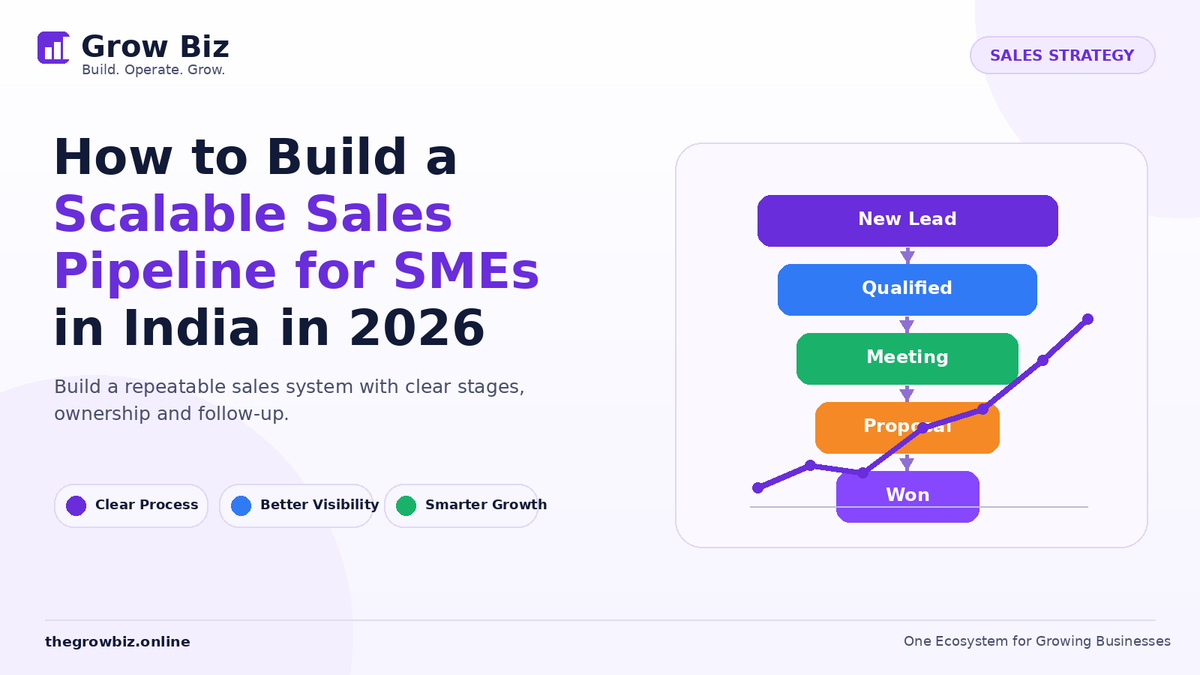
Keep stages simple enough that everyone understands them. A practical B2B pipeline can look like this:
- New Lead
- Contacted
- Qualified
- Discovery Completed
- Proposal Sent
- Negotiation
- Won or Lost
Each stage should have a clear definition. For example, a lead should not become “Qualified” only because someone answered a call. Qualification should confirm fit, need, authority, timing and commercial potential.
3. Set a next action for every active opportunity
A pipeline fails when leads sit without ownership or follow-up. Every active opportunity should have a next action and a next-action date. That may be a call, proposal revision, demo, meeting, document request or decision follow-up.
This simple discipline prevents warm opportunities from being forgotten and makes sales reviews much more useful.
4. Track source quality, not only source volume
Different channels can produce very different outcomes. Measure not only how many leads come from Google, LinkedIn, referrals, events, outbound campaigns or partners, but also how many become qualified opportunities and customers.
A channel that sends fewer leads may still be more valuable if the leads are better matched and close faster.
5. Build a consistent follow-up process
Many B2B opportunities need multiple interactions. Create a follow-up rhythm that adds value instead of repeatedly asking for an update. Share a relevant case example, answer an objection, clarify the proposal, provide a useful checklist or suggest a next step.
Consistency is more important than aggressive pressure.
6. Review the pipeline every week
A weekly sales review should focus on movement and decisions. Look at new opportunities, stalled deals, proposals awaiting response, expected closures, lost deals and reasons for loss. Ask what must happen next, who owns it, and by when.
Over time, this creates a reliable operating rhythm for the sales team.
7. Use the right system as volume grows
Spreadsheets can work at an early stage, but growing teams usually need stronger ownership, permissions, reporting and activity history. A CRM or business operating system helps centralize data and reduce dependence on manual updates across multiple files.
The goal is not to add software for its own sake. The goal is to make the sales process visible, repeatable and measurable.
Final takeaway
A scalable sales pipeline is built from clear targeting, disciplined qualification, consistent follow-up, defined ownership and regular review. Once these basics are strong, lead generation and automation become much more effective because they are feeding a process that can actually convert demand into revenue.
If your sales process needs a clearer structure, explore Grow Biz services or speak with the Grow Biz team.