
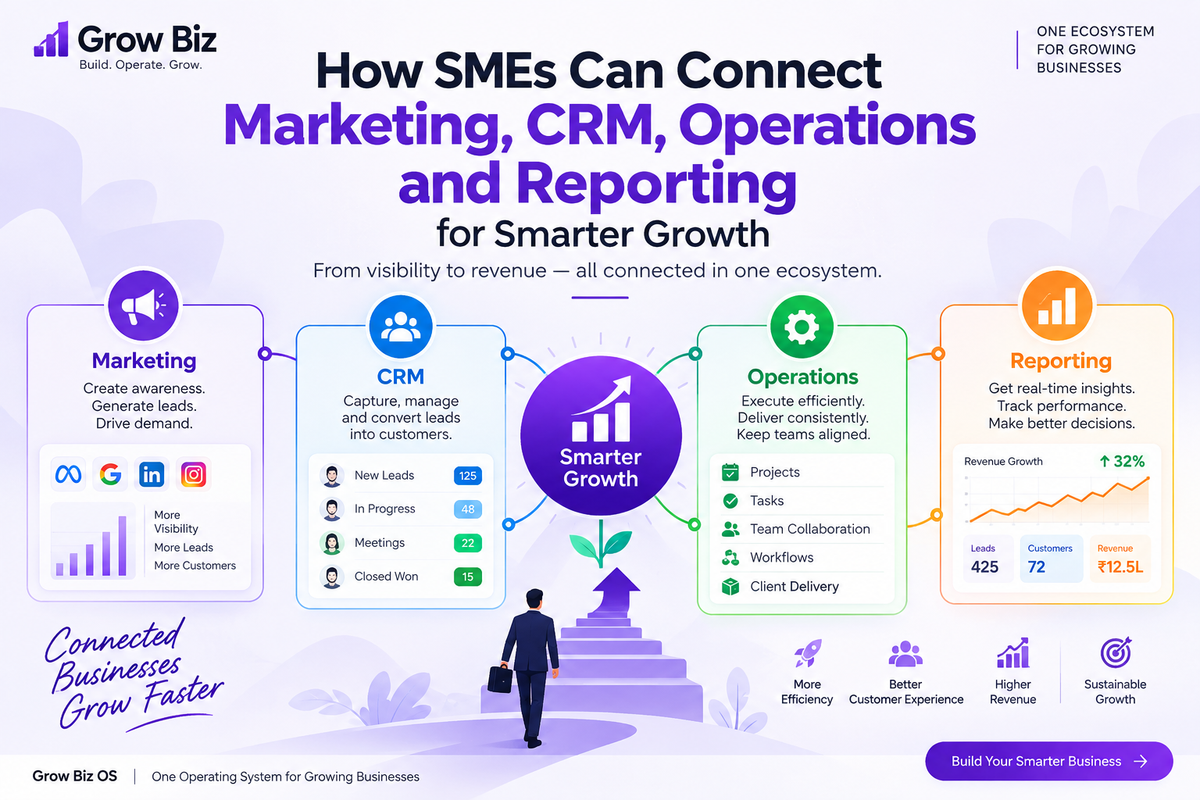
Many SMEs invest in marketing to generate enquiries, then manage those enquiries in a spreadsheet, coordinate delivery through WhatsApp and prepare reports manually at the end of the week. Each tool may work on its own, but the customer journey becomes fragmented. That fragmentation can make it difficult to understand which marketing activity creates useful opportunities, whether leads are being followed up and what happens after a deal is won.
A better approach is to connect marketing, CRM, operations and reporting as one business workflow. This does not require a complicated transformation project. It requires clear ownership, consistent data and a practical system that follows the customer from first interaction through delivery.
What does a connected growth workflow look like?
A connected workflow starts when a prospect discovers the business and continues through enquiry, qualification, sales follow-up, conversion, onboarding, delivery and reporting. Each stage should pass useful information to the next stage instead of forcing teams to recreate context.
For a growing company, the aim is simple: marketing should know what produces qualified demand, sales should know what to follow up, operations should know what was sold, and management should be able to see performance across the journey.
Step 1: Make marketing accountable to business outcomes
Marketing activity should have a defined objective before campaigns begin. Website traffic, impressions and engagement can be useful indicators, but SMEs also need to understand what happens after someone responds.
Capture the source of each enquiry wherever practical. Use clear landing-page calls to action, consistent forms and campaign naming. When a prospect becomes a lead, preserve the original source so the business can later compare channels based on opportunity quality rather than only surface-level traffic.
Improve the path from visitor to enquiry
Every important service page should make the next action obvious. A visitor should quickly understand what the business offers, who it is for and how to continue. Contact forms should ask only for information that is genuinely useful at that stage. On mobile devices, buttons, forms and text should remain easy to use without unnecessary friction.
Step 2: Give every lead a structured CRM journey
Once an enquiry arrives, it needs ownership. A CRM process does not have to be complicated. At minimum, record the contact, company where relevant, requirement, lead source, stage, owner, latest update, next action and follow-up date.
Stages should represent real decisions in the sales process. For example, a business might use New Enquiry, Contacted, Qualified, Meeting, Proposal, Negotiation, Won and Lost. The exact names matter less than using them consistently.
Separate activity from progress
Five calls do not necessarily mean a lead has progressed. Teams should record both the activity and the resulting stage or next step. This helps managers identify whether the problem is insufficient follow-up, weak qualification, proposal quality or another part of the sales process.
Step 3: Create a clean sales-to-operations handoff
Winning a client should trigger a structured handoff rather than another round of messages asking what was agreed. Operations needs the information required to deliver: scope, priorities, key contacts, timelines, documents, dependencies and any commitments made during the sales process.
This is also where clear boundaries matter. If the sales conversation contains assumptions that were never formally agreed, they should be resolved before delivery begins. A consistent handoff protects both the client experience and the internal team.
Step 4: Connect tasks and delivery to the client record
Operational work becomes easier to manage when tasks are connected to the relevant client or project. Team members can see what is due, managers can identify overdue work, and customer-facing employees can understand delivery status without searching through unrelated chats.
Standard checklists can help with recurring work such as onboarding, campaign setup, reporting or content production. However, templates should support judgment rather than replace it. Each client may still have specific requirements that need individual attention.
Step 5: Build reporting from the workflow, not after it
Reporting is most useful when the underlying data is captured during normal work. If employees have to reconstruct the week every Friday, the system is creating administrative work rather than reducing it.
Useful management questions include: How many new enquiries entered the pipeline? Which sources produced qualified opportunities? Which leads have no next action? How many proposals are awaiting decisions? What client work is overdue? Where are handoffs slowing down?
The purpose of a dashboard is not to display as many numbers as possible. It is to make important exceptions and decisions visible.
Step 6: Automate carefully
Automation can reduce repetitive work when the process is already clear. Examples include assigning tasks after a status change, reminding owners about overdue follow-ups, generating routine summaries or triggering onboarding steps after a deal is confirmed.
Do not automate a broken process. If ownership and definitions are unclear, automation can simply make confusion move faster. First establish the workflow, then automate the repetitive parts while keeping people responsible for decisions and customer communication.
How Grow Biz connects growth and operations
Grow Biz is a business growth ecosystem combining consulting, technology, AI, education and corporate solutions to help businesses build, operate, grow and scale. That ecosystem approach is useful because marketing performance cannot be separated completely from the sales and operational systems that handle the resulting demand.
Grow Biz OS is the technology layer focused on connected business operations. Businesses that also need team capability development can explore Grow Biz Academy, the ecosystem's education, training and career-development brand.
Frequently asked questions
What should an SME connect first: marketing or CRM?
Start with the biggest current gap. If enquiries are being generated but lost after they arrive, structure CRM and follow-up first. If the pipeline is organised but demand is insufficient, focus on marketing while preserving source tracking.
Do small businesses need complex dashboards?
No. Start with a small set of actionable measures tied to leads, conversion, delivery and overdue work. Add detail only when it improves a decision.
Can WhatsApp still be part of the workflow?
Yes. WhatsApp can remain an important communication channel. The risk comes when critical business history exists only inside individual chats. Important outcomes and next actions should also be recorded in the business system.
How do we know if our tools are too disconnected?
Common signs include duplicate records, missed follow-ups, frequent requests for status updates, manual weekly reporting, unclear handoffs and difficulty linking marketing activity to actual opportunities.
Connect growth before adding more tools
Before purchasing another app, map the journey from marketing to sales to delivery. Identify where context disappears, where ownership becomes unclear and where employees repeat data entry. Then build a connected workflow around those gaps. To explore a more integrated approach, visit Grow Biz and Grow Biz OS.