
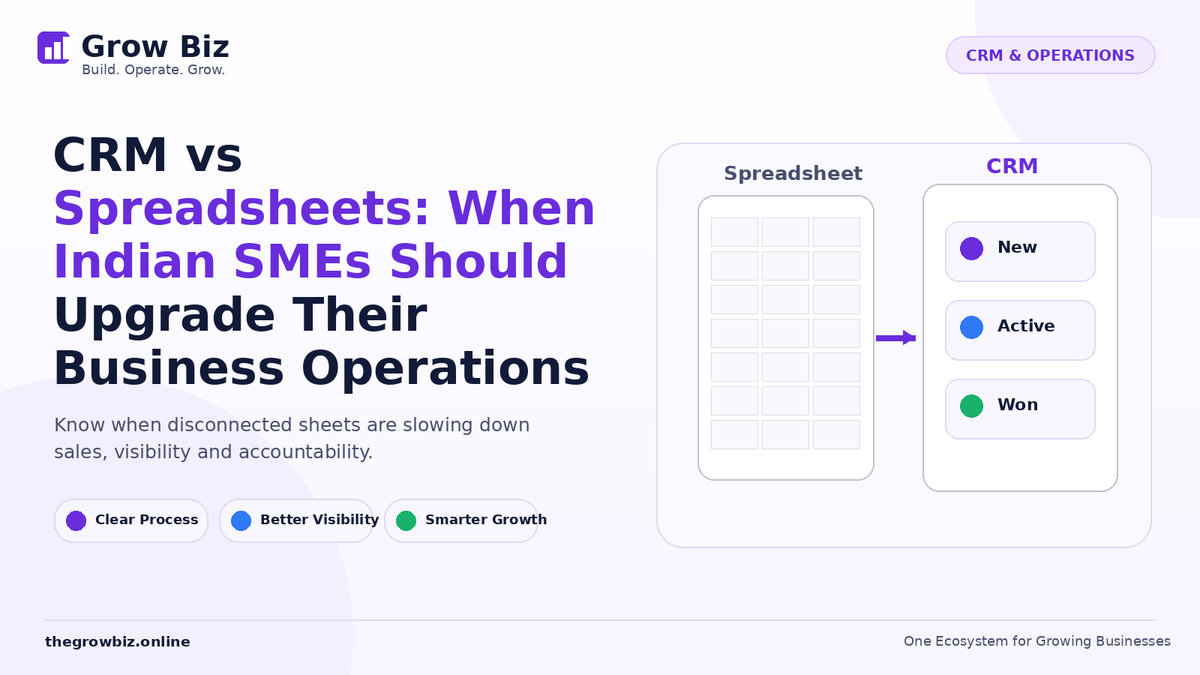
Spreadsheets are one of the most useful tools a growing business can have. They are fast, flexible and familiar. But the same flexibility that makes a spreadsheet useful in the early stage can become a problem when leads, customers, employees, tasks and reports start multiplying.
For many Indian SMEs, the important question is not whether spreadsheets are good or bad. The real question is: when has the business become too complex to run from disconnected sheets?
Short answer: when information starts becoming harder to manage than the work itself
An SME should consider moving from spreadsheets to a CRM or business operating system when teams are repeatedly copying the same data, leads are being missed, follow-ups depend on memory, managers cannot see a reliable pipeline, access permissions are unclear, or reporting takes too much manual effort.
The objective is not to replace every spreadsheet. The objective is to create a dependable system of record for the processes that matter most.
Why spreadsheets work so well at the beginning
Early-stage businesses often need speed more than structure. A founder can create a lead tracker in minutes, a sales manager can add columns for follow-up dates, and an operations team can adapt the sheet whenever the process changes. That flexibility is valuable.
Problems usually appear later, when multiple people edit different versions, formulas break, important fields are left blank, customer history sits across several files, or nobody is sure which sheet is current. A system that worked for a five-person team may not work for a fifty-person organization.
Seven signs your SME is outgrowing spreadsheets
1. Lead follow-up depends on individual memory
If salespeople need to remember who to call, search through WhatsApp, or manually scan rows for overdue follow-ups, the business is carrying avoidable sales risk. A CRM should make the next action visible and assign ownership clearly.
2. The same customer information exists in many places
A prospect may appear in a lead sheet, quotation file, email thread, project tracker and finance sheet. When these records do not connect, teams spend time reconciling information rather than serving the customer.
3. Management reports take hours to prepare
If weekly sales numbers require copying data into a new workbook, checking formulas and asking team members for updates, reporting is too dependent on manual effort. A stronger operating system should convert daily activity into management visibility automatically.
4. Team accountability is unclear
A growing business needs to know who owns each lead, task, project, customer issue or approval. Shared spreadsheets often show the information but do not enforce responsibility, reminders or workflow states.
5. Access control is becoming important
Not every employee should see every salary, customer record, commercial term or management note. As teams grow, role-based access becomes more important than simply sharing a file link.
6. Data quality is declining
Duplicate rows, inconsistent phone formats, missing stages and different naming conventions make analysis unreliable. Structured forms, required fields and standardized workflows help protect data quality.
7. Growth is creating more coordination work
If adding employees creates more meetings, more status requests and more manual checking, the business needs stronger process infrastructure.
What should replace the spreadsheet?
There is no single answer for every SME. Some businesses only need a CRM. Others need a connected business system covering sales, projects, HR, attendance, tasks, finance visibility, documents and reporting.
A practical approach is to identify the highest-friction process first. For example, if sales follow-up is the main problem, begin with lead management and pipeline visibility. If project delivery is the bottleneck, start with tasks, ownership and deadlines. If the organization is growing quickly, employee management and permissions may become equally important.
The goal is to create one reliable operating layer rather than adding many disconnected tools that create a new integration problem.
CRM vs business operating system
A CRM focuses primarily on customer relationships, leads, opportunities, communication and sales activity. A broader business operating system can connect CRM with internal operations such as projects, employees, attendance, workflows, dashboards and reporting.
For a small team with a straightforward sales process, a CRM may be enough. For a growing SME that wants visibility across departments, a broader operating platform can reduce fragmentation.
Grow Biz is building Grow Biz OS around this connected operating model, while Grow Biz Consulting can help businesses identify process gaps before implementing technology.
How to migrate without disrupting the business
Step 1: clean the data before importing
Do not move every old column simply because it exists. Remove duplicates, define standard fields and decide what information is actually useful.
Step 2: define the process before configuring software
Technology cannot fix an unclear workflow. Write down stages, ownership rules, required fields, follow-up expectations and escalation points.
Step 3: migrate one important workflow first
A phased rollout is easier to adopt than changing everything at once. Start with a process that has visible business value.
Step 4: train the team on outcomes, not just buttons
Employees need to understand why the system matters: fewer missed leads, clearer ownership, faster reporting and better coordination.
Step 5: review adoption weekly
A CRM is only useful when it becomes part of the daily operating rhythm. Check whether records are complete, follow-ups are being logged and managers are using the dashboards.
What should stay in spreadsheets?
Spreadsheets still have a place. They are excellent for one-off analysis, temporary calculations, quick models and ad hoc planning. The mistake is using them as the permanent database for processes that require workflow, permissions, history and accountability.
A practical decision test for SME owners
Ask five questions: Can I see my current sales pipeline without asking anyone? Can I identify overdue actions immediately? Is customer information stored in one reliable place? Can I control who sees sensitive data? Can I generate a useful management report without rebuilding it manually?
If several answers are no, the business may already be paying a hidden cost for fragmented operations.
Final takeaway
Moving beyond spreadsheets is not a sign that spreadsheets failed. It is usually a sign that the business has grown. The right time to upgrade is when process complexity, team size and customer volume make manual coordination unreliable.
If you want to map the right next step for your business, explore Grow Biz OS or contact Grow Biz for a business operations discussion.