
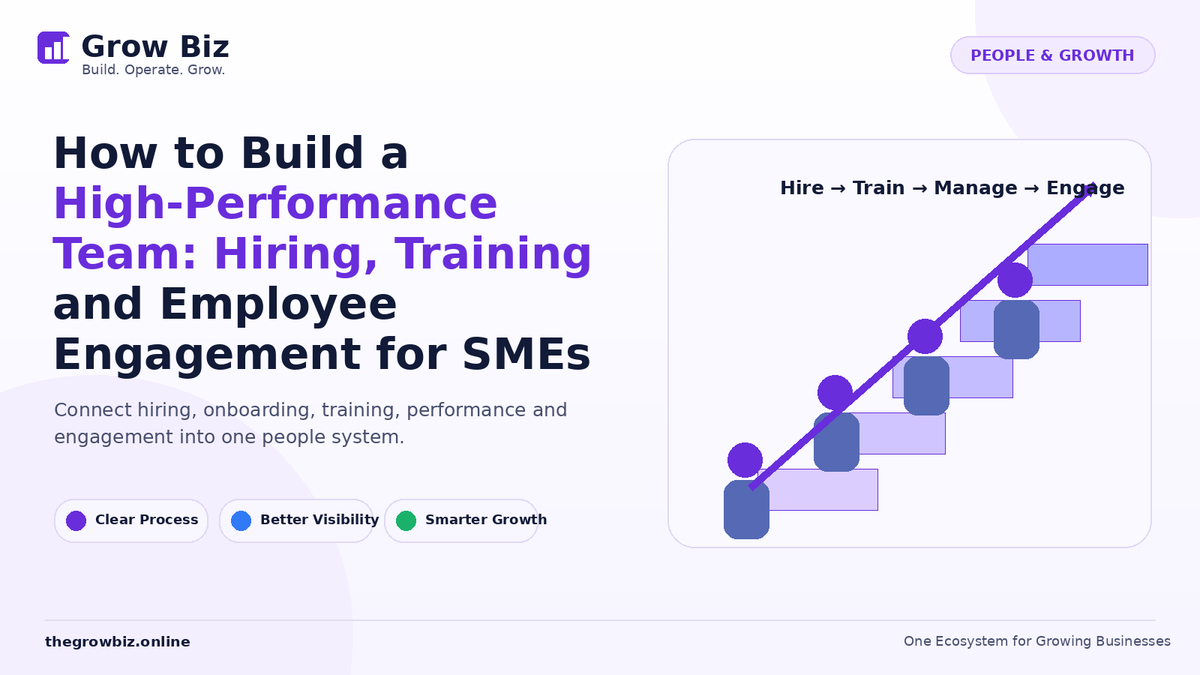
Growing an SME is not only a sales challenge. It is also a people challenge. A company can generate opportunities and still struggle to scale if hiring is reactive, onboarding is inconsistent, employees do not understand expectations, and managers spend too much time solving preventable coordination problems.
A high-performance team is not created by hiring “great people” and hoping everything works. It is built through a system that connects hiring, onboarding, training, performance expectations and employee engagement.
Short answer: hire for role clarity, train for capability and engage through meaningful employee experience
SMEs can build stronger teams by defining roles before recruiting, using structured selection criteria, creating a clear first-90-day onboarding plan, training employees around real business outcomes, setting measurable expectations and recognizing contribution consistently.
Start before the job is posted
Many hiring problems begin with an unclear role. A company knows it needs “someone in sales” or “someone for marketing,” but the actual responsibilities, targets and required skills are not defined.
Before recruiting, write down the business outcome the role owns. Then define recurring responsibilities, key skills, reporting relationship, decision authority and performance measures. This makes candidate evaluation more consistent and makes onboarding much easier later.
1. Build a structured hiring process
A good recruitment process does not need to be complicated. It needs to be repeatable.
Start with a role scorecard. Separate must-have requirements from skills that can be trained. Use the same core interview questions for comparable candidates. Include practical assessments where appropriate. Record reasons for selection or rejection instead of relying only on intuition.
For companies that need support across fresher, experienced, bulk, sales, marketing, IT or non-IT hiring, Grow Biz Recruitment & Placement is the talent-solutions part of the Grow Biz ecosystem.
2. Treat onboarding as part of performance
Hiring does not end when the offer is accepted. The first weeks determine how quickly the employee becomes productive and how clearly they understand the company.
A useful onboarding plan should cover company context, role outcomes, tools, workflows, key people, communication standards, policies and the first set of measurable priorities.
Instead of giving a new employee dozens of documents, organize onboarding around what they need to know in week one, what they should be able to do by day thirty and what independent ownership should look like by day ninety.
3. Train around real work
Training becomes valuable when employees can connect learning directly to their role. Generic sessions may create awareness, but capability usually grows through practice, feedback and application.
A sales employee might need prospecting, discovery, objection handling and CRM discipline. A first-time manager may need delegation, feedback and performance conversations. A founder may need systems thinking, finance literacy or sales management.
Grow Biz Academy focuses on practical business, sales, entrepreneurship, leadership and workforce capability so training can connect more closely with real business requirements.
4. Make expectations visible
Employees cannot consistently perform against expectations that exist only in a manager's head.
Each role should have a small number of clear outcomes and operating expectations. These may include targets, response times, quality standards, project deadlines, customer metrics or activity requirements depending on the role.
The purpose is not to create excessive monitoring. It is to reduce ambiguity. When expectations are visible, performance discussions become more objective and coaching becomes more useful.
5. Build a regular feedback rhythm
Annual reviews are too slow for a growing SME. Managers need shorter feedback cycles.
A simple rhythm can include weekly task or pipeline reviews, monthly one-to-one conversations and periodic role-performance reviews. The exact cadence depends on the team, but feedback should happen while the information is still useful.
Managers should discuss what is working, what is blocked, what support is needed and what specific behavior or result should improve next.
6. Use recognition deliberately
Employee engagement is often reduced to events or gifts. Those can be useful, but engagement is broader. People are more likely to stay connected when they understand the purpose of their work, feel that contribution is noticed, have access to growth opportunities and experience fair management.
Recognition can be simple: specific praise, visibility for good work, learning opportunities, increased responsibility, awards or thoughtful employee gifting at meaningful moments.
For companies building joining kits, festival gifting, employee rewards, branded merchandise or recognition programs, CorporateKart is the employee-engagement and corporate-gifting brand powered by Grow Biz.
7. Connect people operations with business operations
As a company grows, employee information, attendance, tasks, projects, documents and performance data often become fragmented across different tools. This makes management harder and weakens accountability.
A connected business operating system can help bring workforce information closer to the actual work being delivered. Grow Biz OS is being developed around this broader operating model, connecting areas such as employees, CRM, tasks, projects and management visibility.
A practical team-building framework for SMEs
Think of the employee lifecycle as six connected stages:
Define: clarify the role and business outcome.
Hire: use structured evaluation and realistic job expectations.
Onboard: create a clear path to early productivity.
Develop: train for the skills the role actually needs.
Manage: set expectations, review performance and remove blockers.
Engage: recognize contribution, provide growth and create a consistent employee experience.
If one stage is weak, the others become harder. Poor role definition creates bad hiring. Weak onboarding makes training harder. Unclear expectations make performance management feel subjective. Lack of recognition reduces engagement even when compensation is competitive.
What founders should avoid
Avoid hiring only because the team feels busy. Avoid giving every new employee a different onboarding experience. Avoid delaying difficult feedback. Avoid using training as a substitute for unclear management. And avoid assuming employee engagement can be solved with occasional events while everyday work remains confusing.
Final takeaway
A high-performance team is a business system, not a collection of individual hires. SMEs that connect recruitment, learning, operations and employee experience create a stronger foundation for scale.
Grow Biz brings these areas together through Consulting, Recruitment & Placement, Grow Biz Academy, Grow Biz OS and CorporateKart. To discuss what your organization needs next, contact Grow Biz.