
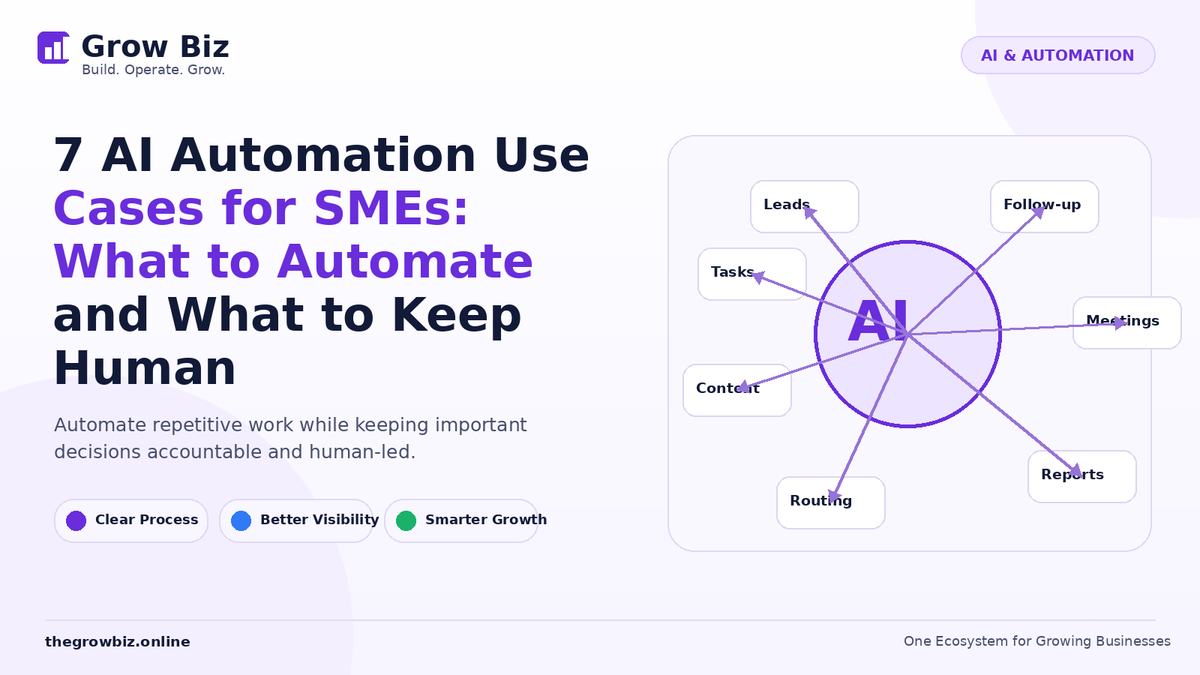
Automation can help a growing business move faster, reduce repetitive work and create more consistent processes. But automation works best when it supports people rather than trying to replace every human decision.
For startups and SMEs, the practical goal is simple: automate predictable administrative work, keep judgment-heavy decisions with people, and connect the two through clear workflows.
What should a growing business automate first?
Start with tasks that are repetitive, rules-based and easy to verify. Good early candidates include routine reminders, task assignment, lead and customer record updates, document routing, recurring internal reports, attendance workflows, status notifications and standard follow-up prompts.
These processes consume time but usually do not require deep judgment on every occurrence. Automating them can give employees more time for customer conversations, problem-solving, creative work and management decisions.
Where should humans remain in control?
Human review is especially important when a decision affects a customer relationship, employee, financial commitment, legal position or brand reputation. Hiring decisions, performance discussions, complex customer complaints, pricing exceptions, strategic recommendations and sensitive communications should have clear human ownership.
AI can assist by organizing information, drafting options or identifying patterns, but the accountable person should understand the context and make the final decision where the impact is significant.
1. Map the workflow before automating it
A common mistake is automating a process that is already unclear. Before adding software, write down the trigger, owner, required information, decision points, output and next step.
For example, an employee onboarding workflow might begin when a new employee is confirmed, create required tasks for HR and the reporting manager, request documents, schedule orientation activities and track completion. Once the process is clear, automation can make it faster without making it confusing.
2. Build one source of operational truth
Automation becomes unreliable when customer, employee, project and financial information is scattered across disconnected spreadsheets and chat threads. A structured operating system gives workflows consistent data to work with.
Grow Biz OS is being developed as one operating system for growing businesses, bringing areas such as CRM, employees, projects, finance, reporting and administration into a connected workspace.
3. Automate handoffs, not accountability
Software can automatically move a task to the next stage, notify the responsible person or generate a reminder. It should not make ownership disappear.
Every important workflow should still answer three questions: Who owns this outcome? What does completion mean? What happens if the workflow fails?
4. Use AI as an intelligence layer
Traditional automation follows predefined rules. AI can add another layer by summarizing information, identifying patterns, preparing reports, suggesting next actions and helping teams query business information in natural language.
The strongest model combines both. Rules handle predictable steps; AI helps interpret information; people remain responsible for important decisions. This is the direction of the Grow Biz AI intelligence and automation layer within the wider Grow Biz ecosystem.
5. Keep customer communication human where it matters
Automated confirmations, reminders and status updates can improve response speed. But high-value sales conversations, complaints, negotiations and relationship-building benefit from a person who understands the customer's situation.
A useful rule is to automate communication that answers “what happens next?” while keeping humans involved when the customer is asking “what should we do?”
6. Measure whether automation actually improves operations
An automation is not successful merely because it runs. Track whether it reduces turnaround time, missed tasks, duplicate work, errors or unnecessary manual effort.
For customer-facing workflows, also monitor whether the change improves response time and completion rates without making the experience harder. For internal workflows, ask employees whether the process removes friction or simply adds another system to maintain.
7. Introduce automation in stages
SMEs do not need to automate the entire company at once. Choose one high-frequency workflow, document it, automate the safe steps, test exceptions and measure the result. Then improve the workflow before expanding to another department.
This staged approach reduces operational risk and helps teams learn how automation should work in their business.
A practical automation framework for SMEs
Automate
Routine reminders, record updates, task creation, recurring reporting, standard notifications and predictable administrative handoffs.
Assist with AI
Summaries, recommendations, information retrieval, draft reports, pattern detection and management insights.
Keep human-led
Strategy, sensitive employee decisions, complex customer situations, negotiations, exceptions and decisions carrying significant financial or reputational impact.
How Grow Biz connects operations, AI and people
Grow Biz is building a connected business growth ecosystem spanning consulting, technology, AI, education, recruitment and corporate solutions. Businesses can use Grow Biz for broader growth support, Grow Biz OS for connected operations, Grow Biz Academy for practical learning and workforce development, and Grow Biz Jobs for job and career activity.
The objective is not automation for its own sake. It is to create a business where information moves reliably, employees know what they own, managers can see what is happening and customers receive a consistent experience.
Frequently asked questions
Should SMEs automate every repetitive task?
No. Prioritize tasks where automation creates a meaningful improvement in speed, consistency or accuracy. A simple manual task that happens rarely may not justify automation.
Can AI replace business managers?
AI can support managers with analysis, summaries and recommendations, but important decisions still require context, accountability and human judgment.
What is the safest first automation project?
Choose a frequent, rules-based process with clear inputs and outputs, limited downside if something fails, and an employee who owns the result.
How do we know an automation is working?
Compare the process before and after implementation using practical measures such as turnaround time, completion rate, errors, missed tasks and employee effort.
Start with the process, then choose the technology
Effective automation begins with understanding how the business should operate. Define the process, assign accountability, connect reliable data and automate only the steps that benefit from automation. That creates a stronger foundation for scaling technology and AI as the business grows.